Replicas!
Replicas!: Len Lye’s Live Art History
By Inga Fraser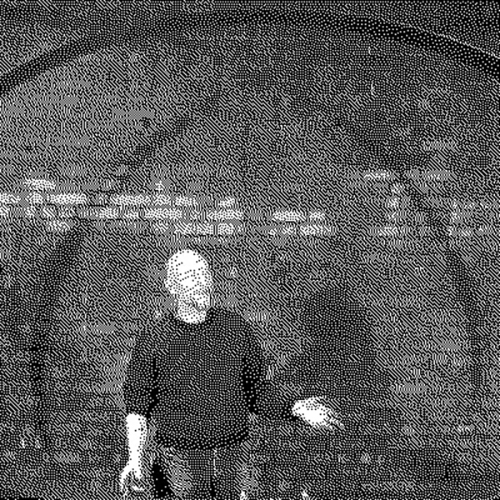
Abstract
Replicas! Len Lye’s Live Art History is composed of a video essay and accompanying text describing, contextualising, citing, and interpreting a mode of address developed by the artist Len Lye towards the end of his life—the performative, multimedia lecture. In his public lectures from the 1960s onwards, Lye looked back over earlier work made in London, reading it in relation to his more recent interest in popular science. To explain how his work from the 1920s and 1930s pre-empted scientific discoveries made decades later, he developed his long-held argument that all art reflects a deep, embodied “genetic” knowledge, which results in artworks that often “look like” their makers—what he termed “replicas”. Lye’s lectures metabolise a wide range of ideas and concepts, bringing five decades of his own work in painting, drawing, sculpture, and film together with the work of other artists. The result is a new live reading—or post-rationalisation—of his own oeuvre. This essay argues that Lye was both artist and art historian in these moments of performance. Today, without the performative persona of Lye and with only fragments of the lectures’ images and audio in the archive, this essay attempts its own “replica” of sorts. By using Lye’s methodology to investigate his archive, it stages once more a productive collision between art historian and artist for a contemporary audience.
Replicas! Part One: Video
Replicas! Part Two: Text
This essay and the accompanying video describe, contextualise, cite, and interpret a particular mode of address developed by the New Zealand-born artist Len Lye in lectures given towards the end of his life that looked back over his earlier work. It does so in the video by experimenting with Lye’s own techniques and methods; these provide the rationale for the chosen format, which the essay (written after the video was made) further explicates and on which it reflects. When lecturing, Lye was both artist and art historian, and here I explore the productive collision of these two sensibilities.
From an early age, Len Lye was preoccupied with the idea of motion as an artistic medium—not just the depiction of moving objects but, as his biographer Roger Horrocks notes, also the composition of movement.1 Born in 1901, Lye lived in Western Samoa and Sydney before relocating to London in 1926. There he established his reputation as an artist and experimental filmmaker, producing several films for the General Post Office (GPO) Film Unit between 1935 and 1937. Though he occasionally worked with film after moving to the United States in 1944, Lye found it difficult to obtain the necessary funds. From the 1950s onwards, sculpture became his primary medium, and he was able to pursue an “art of motion” in his large-scale kinetic works.2 Across different media, he sought to use technological means to appeal to physical or bodily sensations. In sculpture as much as in film, he used sound, vibration, and repetition alongside certain formal motifs to involve viewers in a lively reciprocity with the kinetic spectacles they beheld.3
1In the late 1960s Lye also began to give lectures on his work and beliefs about art. In 1966 he joined the staff at the School of the Arts at New York University where he led a course titled “The Art of Vision”.4 His lectures emphasised the transmedial aspects of the ideas he had explored over five decades as an artist in painting, drawing, sculpture, and film. From his vantage point in the 1960s, Lye further refined these ideas through his broad reading matter—from art magazines to popular science—applying more recently acquired knowledge in the reinterpretation of older work. His lecture “Art and the Genes”, for example, references scientific literature on energy particles and gamma ray radiation and a New York Times article on deep sea bubbles.5 Crucially, in the final part of his career, giving lectures led him back to audiovisual media via the use of 35 mm slide presentations. He would frequently also screen his own films and make use of recorded audio as part of his presentations. As live multimedia events, Lye’s lectures were distinctive, yet highly ephemeral. Horrocks describes how the artist
4The extensive notes and scripts Lye made for his lectures are now preserved in his archive, along with many of the slides he used. However, as creative remixes or reinterpretations, these lectures are undoubtedly best understood in the moment of their delivery. This is also underscored by Lye’s distinctive physicality when speaking. The film-maker and author Cecile Starr, who heard him lecture, recalled:
7One word would lead, in mid-sentence, to connect up with another thought that would in turn lead somewhere else, and Len provided the punctuation by waltzing around the room, twisting and turning himself around in a kind of syncopation to the ideas. . . . One felt that these ideas were all over the room; he had only to look up in one direction and there came an idea; if he stumbled as he talked it was because another idea lay at his feet; when he swung his arm to help make a pivoting turn, he fairly knocked into another idea; he gave each of them a nod of recognition.7
This combination of prepared notes and post-rationalisation, with his all-body improvisational disquisition, constitutes what I think of as Lye’s live art history. This mode and method of thinking with and about art is grounded in the dialectical relationship between past and present, and refers to Lye’s own theory of the interaction between the “old brain”, which he associated with the body, the senses and the unconscious, and the “new brain”, which he defined as relating to more academic and textual learning and to the conscious mind.8
8Lye’s freedom in practising this live art history in his lectures was made possible by the fact that his own work was most frequently under scrutiny. This gave him the artistic licence to revisit and reinterpret forms and meaning, but he was also willing to extrapolate from his own practice to understand that of other artists. In November 1968 Lye was in England to lecture at the Cambridge Animation Festival. The venue was Lady Mitchell Hall, a large lecture theatre at the University of Cambridge. Before a packed audience Lye presented a “complex three-hour presentation” in two parts: “Art and the Body” and “Art and the Genes”.9 He proceeded to compare photographs of artists such as Henry Moore, Willem de Kooning, and Claes Oldenburg with their artworks, and of designers such as Vico Magistretti and Tobia Scarpa with their chairs, claiming these objects were, in a deep sense, “replicas” of their makers, finding in their forms and construction “unconsciously depicted information which could only have been derived from the genes”. In his own words, this was “how genetic juices seep into art”.10
9One audience member in Cambridge, the film-maker Arthur Cantrill, recalls how in the lecture Lye “used films, slides, and audio tapes, and needed the aid of three assistants. It was a performance as much as a talk”.11 These lectures found later iteration in public presentations such as “Religious Genes Goal” and “Genes-God Happiness”, presented at the Institute of Animal Genetics in Scotland,12 but evidently not all audiences found Lye’s presentations intelligible. Commenting on a lecture titled “A Saga of the Creative Imagination”, given at the Second Festival of the Arts Today in Buffalo, New York, in March 1968, for example, Horrocks describes “a barrage of ideas, films, slides and audio tapes, which listeners found baffling but fascinating”.13 Cantrill remembers the artist at the Cambridge lecture “dancing from sentence to sentence”, “full of vitality”, and “bouncing about on the stage with his gleaming bald head and primary red pullover”.14 Lye’s lecturing style, incorporating the dynamism and rhythm of his kinetic sculptures and hand-painted films, was, as Lye argued of his work in other media, a “replica” of sorts. His delivery took the classic pedagogical tool of art history—the comparative slide presentation—and reconfigured it as a more creative, personal, and embodied mode of address. In doing so, he combined formalist, historicist, auto-ethnographical, and artistic approaches to the material at hand. In my seeking to explore his lectures here, a comparably generative approach also seems appropriate—a replica of a replica, perhaps?
11Lye himself began the process of replicating his live lectures by recording excerpts from his talks on tape so they could later be synchronised with the photographic slides. Using this material, Horrocks compiled seven discrete talks, which were published in 2003 by the Len Lye Foundation and the Govett-Brewster Art Gallery as a DVD entitled Len Lye Talks About Art, a hugely valuable record of the scope and style of the lectures and the type of imagery and references Lye deployed.15 With durations of just under ten minutes, these edited talks are more succinct than Lye’s live presentations, which lasted two hours or more.16 Lye’s embodied mode of delivery, which proved so powerful for audience members such as Starr and Cantrill, further distinguishes this format from the original event but cannot be reconstituted. Ironically, any art historian seeking to evoke the special qualities of Lye’s lectures faces much the same problem that galvanised the artist’s own work: how to describe, capture, and convey movement satisfactorily. The problem bears comparison to those encountered in the documentation and preservation of performance art, as a “volatile, intangible, precarious, and (de)materialised” form.17 Conservation strategies for works of performance art (developed in the context of museum acquisition) depend on in-depth interviews with living artists alongside research into historic iterations of the works to guide any future activations.18 In the case of Lye’s lectures, all that remains are the more traditional forms of documentation: photographs and other imagery, audio recordings, and written accounts.
15One means of summoning a “replica”, I propose, is to utilise some of the creative principles behind Lye’s live art history, which might be employed as a methodology. Since the publication of the “Len Lye Talks About Art” series, the Len Lye Foundation has digitised all his audio tapes and photographic slides in a process managed by Paul Brobbel, the former Len Lye curator at the Govett-Brewster Art Gallery. Like the related material in the paper archive, the digitised archive of audio and images is at times repetitious and partial. Because Lye extracted, joined together, and reconstituted the same materials across many different lectures, the task of definitively matching audio to distinct visual slides difficult. Using the material to produce a straightforward reconstruction also feels inappropriate, given Lye’s inclination, which I have already outlined, towards creative, contemporary post-rationalisation and performance in his role of critic or art historian.
As a result, rather than lean on any precise sequence preserved in the archive in the making of the video section of this feature, I followed Lye’s own creative approach. The Replicas! video accompanying this text is drawn primarily from newly digitised slides that exist within the file for his lecture “Art and the Genes” and the associated digitised audio in the Len Lye Centre archive.19 I also include two additional items from the archive: a scan of a two-page letter to Lye from Roger Fry and my own photograph of a handwritten and illustrated storyboard taken during my research visit to the Len Lye Centre in 2019. I did not predetermine a structure, but instead assembled the film instinctively, following Lye’s own valorisation of intuition in his work. Responding to his mother’s request for an explanation of his first film, Tusalava, for example, Lye first answered, “I can’t explain it, you’ve got to see it to believe it”.20 Coincidentally, the reference to Tusalava in the “Art and the Genes” lecture and in the Replicas! video signals this dimension of imitation in his use of the Samoan phrase tusa lava for his title, meaning “just the same”.21 In the absence of his embodied presence as lecturer, I attempted—via the selection and placement of imagery and audio; decisions around movement, duration, and counterpoint of sound and image (for example, linking the movement of the frame with the propellant power of Lye’s words); and humorous juxtaposition—to bring a sense of Lye’s performative persona into the video. This is my attempt at a “replica”.
19The use of audiovisual formats as a tool of description and critical analysis may be a relatively recent development among academics, but this shouldn’t be seen in isolation. Rather, it is connected to the history of documentary and of the essayistic in film. The “essay film”, which emerged as a category in the late 2000s, represents a consistent way of working that dates back to the 1930s—as Laura Rascaroli has observed, citing the work of Isidore Isou, Alain Resnais, Chris Marker, Agnes Martin, and Guy Debord, to name just a few—and has been used in connection with a range of disciplines and subject matter, including art history, and has resulted in works of great nuance, sophistication, and aesthetic merit.22 Timothy Corrigan describes the essay film as having “the look of a documentary filtered through a more or less personal perspective”, which can, depending on the film-maker, involve greater or lesser degrees of formal experimentation.23 Grounded in extensive archival research undertaken as part of my doctorate, Replicas! attempts to channel Lye’s—and inevitably my own—“personal perspective” through such an essayistic experiment. In undertaking this project I found in Lye’s lectures a methodology of live art history that is creative, intuitive, and animate, which may be adapted to work with the associated archive materials to yield—albeit in a different format—an affective interpretation consonant with Lye’s own approach as an artist and public speaker. By including himself as a subject in his lectures, and by preparing his archive in advance, Lye has essentially written the first draft of his own art history, creating an open space of contemporary, associative interpretation and analysis that we now have the option to extend in scholarship.
22Acknowledgements
The original research that informs this essay was made possible through Arts and Humanities Research Council (AHRC) funding in 2019, which enabled a three-week visit to the Len Lye Centre at the Govett-Brewster Art Gallery in New Plymouth, New Zealand. A grant from the Henry Moore Foundation in 2023 enabled further research and funded the writing of this essay and the making of the accompanying digital video.
About the author
-
 Inga Fraser, a curator and art historian, is Senior Curator at Kettle’s Yard, University of Cambridge. Her exhibition Christopher Wood in Love will open in February 2027. Before joining Kettle’s Yard, she worked as a freelance curator at Tate Britain on the exhibition Women in Revolt! Art and Activism in the UK 1970–1990. Her PhD (2016–23), a collaborative doctoral partnership between Tate and the Royal College of Art, explored artists’ engagement with film in the first half of the twentieth century in London, focusing on intermedial practices and the developing discourse of artists’ moving image. Before beginning her PhD, she was Assistant Curator of Modern British Art at Tate (2013–17), where she curated displays including Paule Vézelay (2017) and co-curated exhibitions including Paul Nash (2016) and Barbara Hepworth: Sculpture for a Modern World (2015). She has been a Visiting Lecturer at the Royal College of Art and an Associate Lecturer at the Courtauld Institute of Art, and previously held curatorial positions at the National Portrait Gallery (2011–13) and Central Saint Martins in London (2009–11).
Footnotes
-
1
Roger Horrocks, Len Lye: A Biography (Auckland University Press, 2001), 17, 27. ↩︎
-
2
Further detailed description and critical analysis of Lye’s life and work can be found in Roger Horrocks, Art that Moves: The Work of Len Lye (Auckland University Press, 2009), 88–101, and Zizz! The Life and Art of Len Lye: In His Own Words (Awa Press, 2015), as well as in Paul Brobbel, Wystan Curnow, and Roger Horrocks, eds., The Long Dream of Waking: New Perspectives on Len Lye (Canterbury University Press, 2017). ↩︎
-
3
I discuss this at length in the final chapter of my doctoral thesis. Inga Fraser, “Artists’ Moving Image: Film and Modern Art in Britain 1900–1940” (PhD thesis, Royal College of Art, 2024). ↩︎
-
4
Horrocks, Len Lye, 386. ↩︎
-
5
Len Lye, “Art and the Genes I”, typescript, Len Lye Archive, Len Lye Foundation Research Centre, Govett-Brewster Art Gallery, New Zealand. ↩︎
-
6
Roger Horrocks, ed., “Len Lye Talks About Art—Art of the Old Brain”, 2020, The Len Lye Foundation, https://www.lenlyefoundation.com/page/art-of-the-old-brain/4/93/. ↩︎
-
7
Cecile Starr, letter to Roger Horrocks, cited in Horrocks, Len Lye, 387. ↩︎
-
8
Horrocks, “Art of the Old Brain”. ↩︎
-
9
Arthur Cantrill, “The Absolute Truth of the Happiness Acid”, Senses of Cinema 19 (March 2002), https://www.sensesofcinema.com/2002/feature-articles/lye-2/. ↩︎
-
10
Len Lye, cited in Cantrill, “The Absolute Truth”. ↩︎
-
11
Horrocks, Len Lye, 341. ↩︎
-
12
Horrocks, Len Lye, 341. ↩︎
-
13
Horrocks, Len Lye, 393. ↩︎
-
14
Cantrill, “The Absolute Truth”. ↩︎
-
15
Roger Horrocks, ed., “Len Lye Talks About Art”, The Len Lye Foundation, 2020, https://www.lenlyefoundation.com/page/len-lye-talks-about-art/4/90/. ↩︎
-
16
Horrocks, Len Lye, 386. ↩︎
-
17
Louise Lawson, Duncan Harvey, Ana Ribeiro, and Hélia Marçal, “The Living Process of Conserving Performance: Theory and Practice in the Conservation of Performance-Based Artworks at Tate”, in Conservation of Contemporary Art: Bridging the Gap Between Theory and Practice, ed. Renée van de Vall and Vivian van Saaze (Springer, 2024), 317. ↩︎
-
18
“Strategy and Glossary of Terms for the Documentation and Conservation of Performance”, published as part of Documentation and Conservation of Performance (March 2016–March 2021), a Time-Based Media Conservation project at Tate, https://www.tate.org.uk/about-us/projects/documentation-conservation-performance/strategy-and-glossary. ↩︎
-
19
Len Lye, “Art and the Genes”, Len Lye Archive, Len Lye Foundation Research Centre, Govett-Brewster Art Gallery, New Zealand. ↩︎
-
20
Len Lye, No Trouble (Seizin Press, 1930), 12. ↩︎
-
21
Horrocks, Len Lye, 116. ↩︎
-
22
Laura Rascaroli, How the Essay Film Thinks (Oxford University Press, 2017), 1. ↩︎
-
23
Timothy Corrigan, The Essay Film: From Montaigne, After Marker (Oxford University Press, 2011), 4. ↩︎
Imprint
| Author | |
|---|---|
| Date | 30 September 2026 |
| Category | Look First |
| Review status | Peer Reviewed (Editorial Group) |
| License | Creative Commons Attribution-NonCommercial 4.0 International (CC BY-NC 4.0) |
| Downloads | PDF format |
| Article DOI | https://doi.org/10.17658/issn.2058-5462/issue-30/ifraser |
| Cite as | Fraser, Inga. “Replicas! Len Lye’s Live Art History.” In British Art Studies. London and New Haven: Paul Mellon Centre for Studies in British Art and Yale Center for British Art, 2026. https://doi.org/10.17658/issn.2058-5462/issue-30/ifraser. |